Vitamins
Vitamins are nutrients that our bodies need in small amounts so they can work properly.
If you are on the Healthy Start scheme and want to find out where you can get free vitamins, click here.
If you are not on the scheme, some NHS trusts and boards may still offer the vitamins for free or sell them – just ask your midwife or health visitor.
Why vitamins are important
Even though most people can get all the vitamins they need by eating a healthy, balanced diet, there are certain times in your life when you may not be able to get everything you need from food alone – like when you are planning a pregnancy, when you are pregnant, when you are a new mum or if you are a small child.
Vitamins for pregnant and breastfeeding women
Making sure you have enough of some specific vitamins in pregnancy is important for your own health and for the development of your baby.
Folic acid is important because it reduces the chances of your baby being born with a neural tube defect such as spina bifida (a birth defect where the spine doesn’t form properly).
All women who are pregnant or planning a pregnancy should take a supplement containing 400 micrograms of folic acid a day until the 12th week of pregnancy. It’s also safe to carry on taking folic acid beyond the 12th week of pregnancy. If you don’t take folic acid before you conceive, you should start taking it as soon as you know you are pregnant.
Some women have an increased risk of having an NTD-affected pregnancy and should take a higher dose of 5 mg of folic acid each day until the 12th week of their pregnancy. You have an increased risk if you:
- have had a baby with an NTD
- have diabetes
- (or your partner) have an NTD or a family history of NTDs.
In addition, if you have diabetes or are taking anti-epileptic medicines, you should consult your GP for advice as you may need to take a higher dose of folic acid.
You should also eat foods containing folate (the natural form of folic acid), which is found in foods such as peas, broccoli, spinach, spring greens, granary and wholemeal breads and chickpeas. Some foods such as fortified breakfast cereals have folic acid added to them.
Vitamin C helps maintain healthy tissue in the body. Our bodies can’t store vitamin C, so you need to get some every day.
You can find vitamin C in lots of foods, including peppers, broccoli, oranges, kiwifruit and sweet potatoes.
Vitamin D helps your body absorb calcium, keeping your bones healthy and helping to make sure that your baby’s bones and teeth grow strong. Babies born with low levels of vitamin D can sometimes develop softened bones, which can lead to rickets. Taking vitamin D during pregnancy will ensure that your baby has enough stored in their body for the first few months of their life.
The main source of vitamin D is summer sunlight, and it can be hard to get enough in the UK to last through the winter months. The amount of time you need to spend in the sun to make enough vitamin D is different for every person and depends on things like skin type, time of day and time of year. But you don’t need to sunbathe; no matter what your skin type, the amount of sun you need is less than the amount that causes tanning or burning.
UK Health Departments recommend that all pregnant and breastfeeding women take a daily supplement that contains 10 micrograms of vitamin D.
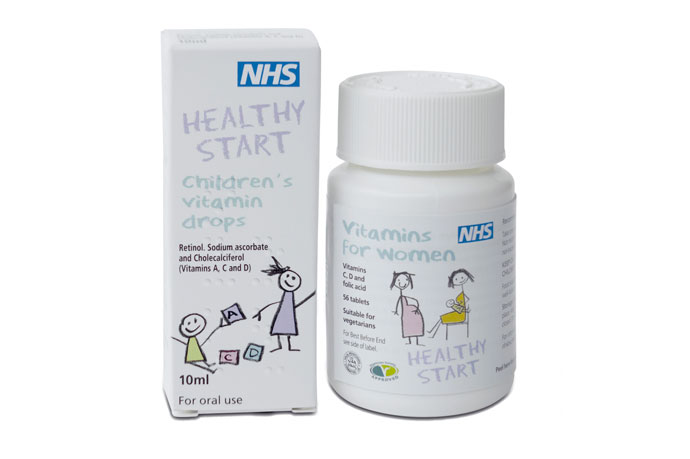
Healthy Start vitamins are specifically made for pregnant and breastfeeding women and contain folic acid and vitamins C and D.
Vitamins for children
Vitamin A is important for keeping your child’s immune system healthy, can help vision in dim light and supports healthy skin. Good food sources are milk, cheese and eggs. Foods such as carrots, green leafy vegetables, red peppers and apricots contain beta-carotene, which the body can make into vitamin A.
Vitamin C helps maintain healthy tissue in the body. Our bodies can’t store vitamin C, so you need to get some every day. Young children, who can be fussy eaters, might not get enough from their diet alone.
You can find vitamin C in lots of foods, including peppers, broccoli, oranges and sweet potatoes.
Vitamin D helps your body absorb calcium, keeping your bones and teeth healthy. Babies born with low levels of vitamin D can sometimes develop softened bones, which can lead to rickets.
The best source of vitamin D is summer sunlight, and it can be hard to get enough in the UK to last through the winter months.
UK Health Departments recommend that all babies aged from six months onwards should be given a supplement that contains vitamins A, C and D, such as Healthy Start vitamin drops, unless they are drinking 500ml (about a pint) of infant formula a day (infant formula has vitamins added to it). You can continue to give young children a supplement containing vitamins A, C and D until they are five years old, as this will help to make sure that they are getting enough of these vitamins. This is especially important when they are learning to eat a variety of foods and if they are fussy eaters.